
 Arabic
  English (United States)
  Spanish
  French
  Turkish
  Japanese
  Ukrainian
  Russian
  Korean
  German
  Dutch
Dutch  Hungarian
  Polish
  Italian
  Indonesian
  Portuguese
  English (UK)
A radar speed camera does two jobs in one device. It measures each vehicle’s speed with radar, and it captures that vehicle on camera. When a driver speeds, the system records the image, reads the licence plate, and logs the speed, time, and location as evidence. A plain security camera only films the scene. A radar speed camera films it, measures it, and proves it.
This article explains how a camera with speed radar works, what separates a basic unit from a full enforcement system, and the pain points it solves for you. You will also see the exact features to compare, where these cameras are used, and how to choose the right one for your road or site.
What Is a Radar Speed Camera?
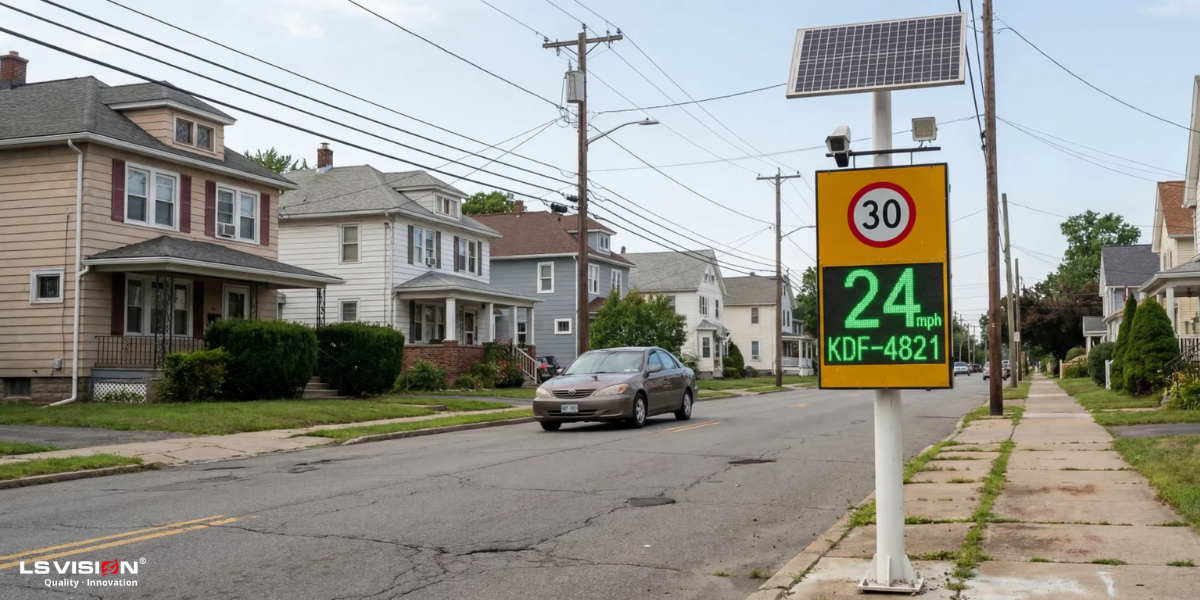
A radar speed camera is an all-in-one traffic device. It combines three technologies in a single housing: a radar sensor, a video camera, and automatic number plate recognition (ANPR). Together, they detect a vehicle, measure its speed, and identify it — all in real time.
You may see the same device called a speed radar camera, a camera with speed radar, an ANPR speed camera, or a speed enforcement camera. The names change. The core job stays the same: it links speed to a licence plate, so you get a complete record of who was driving too fast.
This is where radar-video fusion matters. Radar measures speed accurately in any light and any weather. The camera captures a clear image and reads the plate. Neither tool does the full job alone. A radar gun measures speed but records nothing. A normal camera records everything but measures nothing. Fuse them, and you get precise speed plus hard visual proof in one shot.
Keep one distinction clear from the start:
- A security camera with speed radar records video and flags speed. It is built for monitoring and awareness.
- A speed enforcement camera adds certified-grade capture, plate reading, and an evidence trail. It is built to support penalties.
Both start from the same idea — a camera that sees speed. You choose the grade based on whether you want to monitor, deter, or formally enforce.
How a Radar Speed Camera Works
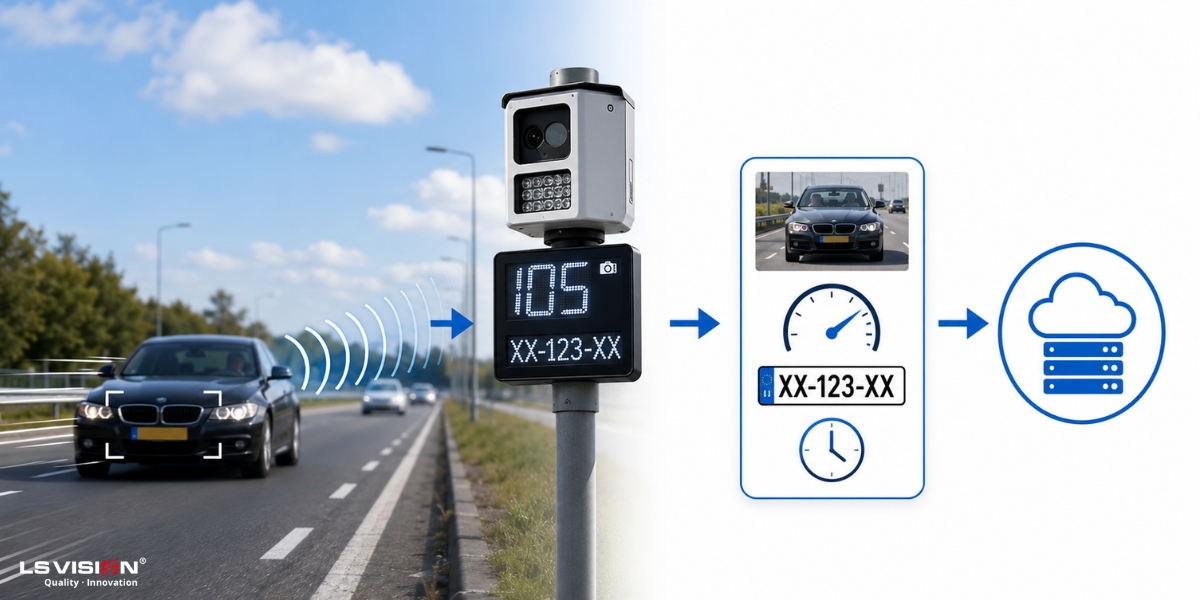
The whole process finishes in a fraction of a second, before the vehicle clears the sensor. Here is each step.
| Step | What the system does |
| 1. Detect | The radar picks up an approaching vehicle and measures its speed using the Doppler effect. |
| 2.Compare | The system checks that speed against the limit you set for the lane or zone. |
| 3. Trigger | If the vehicle is over the threshold, the radar triggers the camera to capture it. |
| 4. Capture | The camera records a high-resolution image, and often a short video, of the vehicle. |
| 5. Read | ANPR reads the licence plate from the image using optical character recognition. |
| 6. Package | The system bundles the speed, plate, time, date, and location into one evidence record. |
| 7. Send | It stores the record and pushes it to a management platform for review or action. |
Now look closer at the parts that decide how well the camera performs.
The radar reads speed with the Doppler effect. A quality unit uses a 24 GHz millimetre-wave radar. It sends out a radio signal, then measures how the reflected signal shifts as the vehicle moves toward it. That shift gives an accurate speed reading in real traffic — day or night, in rain, fog, or dust. Radar does not care about lighting the way a camera does.
You set the violation threshold. The camera does not treat every car as an offender. You set the speed limit for the location, and often a small tolerance over it. Only vehicles above that line trigger a capture. So you decide what counts as speeding on your road.
The camera and ANPR turn a moment into evidence. A speeding car passes in a blink, so the camera must freeze it cleanly and read the plate. Built-in infrared lets it capture clear plates at night, without relying on a bright flash. The result is a usable record: this plate, at this speed, at this time and place.
Radar Speed Camera vs. Security Camera vs. Speed Sign
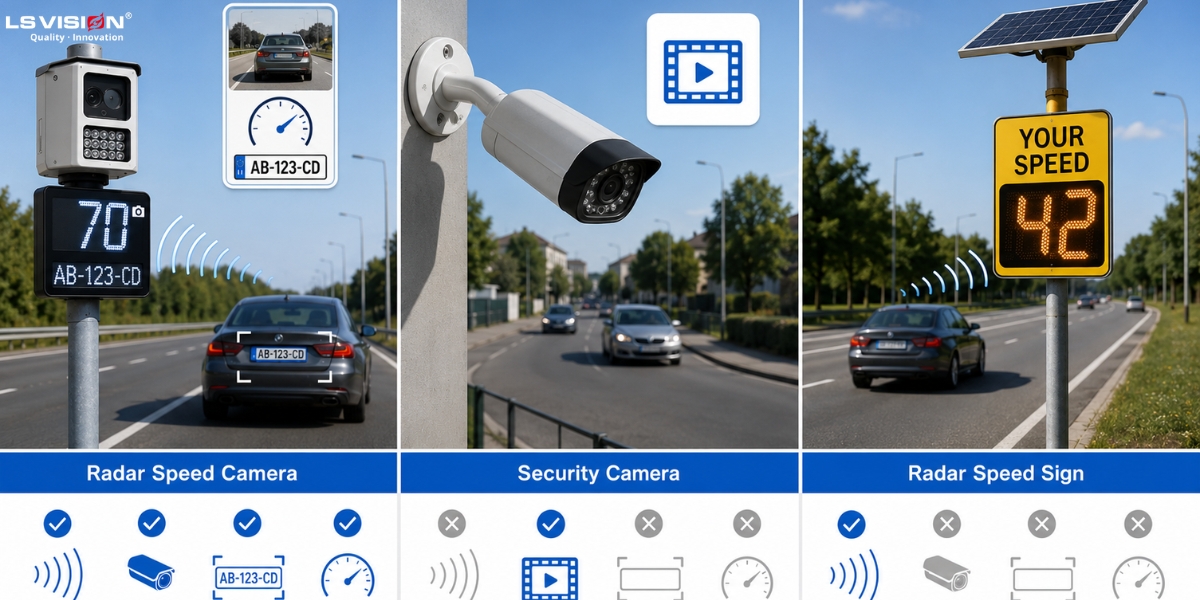
Buyers mix these three up all the time, and the wrong choice wastes money. Here is the clear difference.
| Feature | Radar speed camera | Standard security camera | Radar speed sign |
| Measures speed | Yes, with radar | No | Yes, with radar |
| Records the vehicle | Yes, with ANPR plate capture | Yes, video only | No |
| Reads licence plates | Yes | No | No |
| Warns the driver | Optional (LED display) | No | Yes |
| Main job | Capture and enforce | General monitoring | Warn and calm traffic |
| Best for | Enforcement and evidence | Surveillance | Behaviour change |
A standard camera shows you that a car sped past, but it cannot tell you how fast or who it was. A speed sign warns drivers but keeps no record. A radar speed camera does both jobs the other two miss: it measures the speed and it captures the vehicle. If you need proof, you need the camera.
The Pain Points a Radar Speed Camera Solves
Before you compare products, look at the problems that push buyers toward this technology. You likely recognise a few.
You cannot prove who was speeding. Complaints roll in, but a plain camera gives you no speed and a radar gun leaves no image. You need speed and plate in the same record. A radar speed camera delivers exactly that.
Manual enforcement drains your staff. An officer with a radar gun covers one spot, for a few hours, at high cost. A fixed camera works every hour of every day, with no one on site.
Poor light and bad weather ruin your footage. Standard cameras fail at night, in glare, and in rain — the very moments you need a clear plate. Radar keeps measuring speed in any condition, and infrared keeps the plate readable after dark.
Your speed data and plate data live in separate systems. When speed sits in one tool and plates in another, every case takes manual work to match. A fused radar-and-ANPR camera links them automatically, so each violation arrives as one clean record.
Passive cameras do not deter anyone. Drivers ignore a camera that does nothing visible. Pair the camera with an LED display that shows a driver their speed, and you warn and record at the same time — you deter first, and enforce when needed.
A radar speed camera answers all five. It measures, it captures, it reads, it links, and it deters. That is why it replaces a patchwork of tools with one reliable system.
Key Features That Separate a Professional Radar Speed Camera
Two cameras can look alike and perform nothing alike. Check every point below before you buy. The details decide whether your evidence holds up.
| Feature | Why it matters | What to look for |
| Radar type | Sets speed accuracy and all-weather reliability | 24 GHz millimetre-wave radar |
| Speed range | Must cover your road’s real speeds | A wide range, such as 0–199 km/h |
| Detection distance | Sets how early the system reacts | A long monitoring distance, around 120 m |
| Plate recognition | Turns an image into an identity | Accurate ANPR / LPR reading |
| Capture views | You need the plate and the scene | Close-up for the plate, plus an overview shot |
| Night capture | Violations happen after dark too | Built-in infrared for clear night plates |
| LED display | Warns drivers and adds a deterrent | Shows speed, plate, or a custom prompt |
| Display size | Bigger screens read from farther away | Options such as 640×640 mm and 640×1280 mm |
| Weatherproof build | Survives heat, rain, and dust year-round | Sealed, rugged outdoor housing |
| Power options | Off-grid and fixed sites differ | Solar with battery, or AC mains |
| Evidence output | Cases need a full, credible record | Speed, plate, time, date, and location together |
| OEM / ODM support | Lets you brand or tailor the system | Custom hardware, display, and configuration |
Read this as a checklist, not a wish list. Match each point to your project. A quiet private road and a national highway do not need the same unit. And always confirm the evidence output. A capture that lacks speed, plate, time, or location is not proof — it is just a photo.
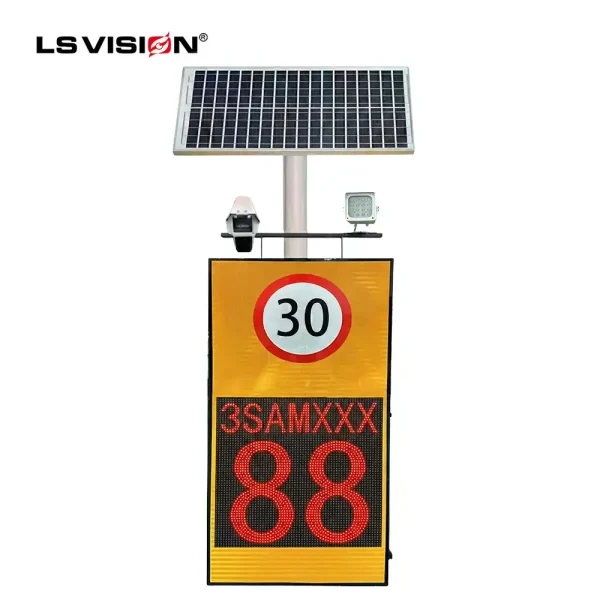
LS-RSM10-SP Automated Traffic Enforcement System with Solar Panel
Connectivity Options
- Available with RJ45 Ethernet or 4G connectivity
- Integrated radar speed detection
- License plate recognition
- LED warning display
- Traffic data platform — all in a single traffic monitoring system
- Urban roads
- School zones
- Residential streets
- Construction areas
- Accident-prone areas
- Factory-direct supply
- Flexible OEM/ODM customization
- Stable delivery
- Long-term technical support
The Management Platform: From Footage to Enforcement Data
A camera captures a violation. A platform turns thousands of violations into something you can act on. This back-office software is what separates a real enforcement system from a lone camera on a pole.
A strong platform gives you:
- Real-time passing-vehicle data. You watch every vehicle log in live, with its speed, plate, and time.
- Split speeding and normal lists. The system sorts speeding vehicles from compliant ones, so you focus only on violations.
- A GIS map of your devices. You see every camera on a live map, with status and location at a glance.
- Alerts and alarms. The system flags violations instantly, and can trigger a voice or light alarm on site.
- Blacklist and whitelist control. You tag vehicles, so a flagged plate raises an alert the moment it passes.
- Section (interval) speed measurement. You measure average speed between two points, not just at one spot.
- Reports and playback. You pull records, review footage, and export evidence when you need it.
- Mobile access. You check the system from a phone through a mini-program, wherever you are.
- Multi-level accounts. You give each team member the right access, from operator to administrator.
→ Video slot: embed the platform demo video here — showing the live dashboard, GIS map, and real-time speeding-vehicle data. Suggested title: “LS VISION Automated Traffic Enforcement System — Speed Detection, ANPR & Traffic Data Platform Demo”.
The lesson is simple. When you buy a camera with speed radar, ask about the platform behind it. Great hardware with weak software still leaves you doing manual work.
Violations a Radar Speed Camera Can Catch
Speeding is the headline, but a modern system watches for more. Depending on the configuration, one camera can flag several problems.
| Violation | How the camera catches it |
| Overspeed | Radar measures speed, and the camera captures anything over your threshold |
| Repeat or flagged vehicles | ANPR matches plates against your blacklist and alerts you |
| Average-speed breaches | Section measurement compares entry and exit times between two points |
| Unregistered access | The system logs every plate entering a site, with time stamps |
You get more than a speed trap. You get a record of who came, when, and how fast — useful for safety, for access control, and for planning.
Where Radar Speed Cameras Are Used
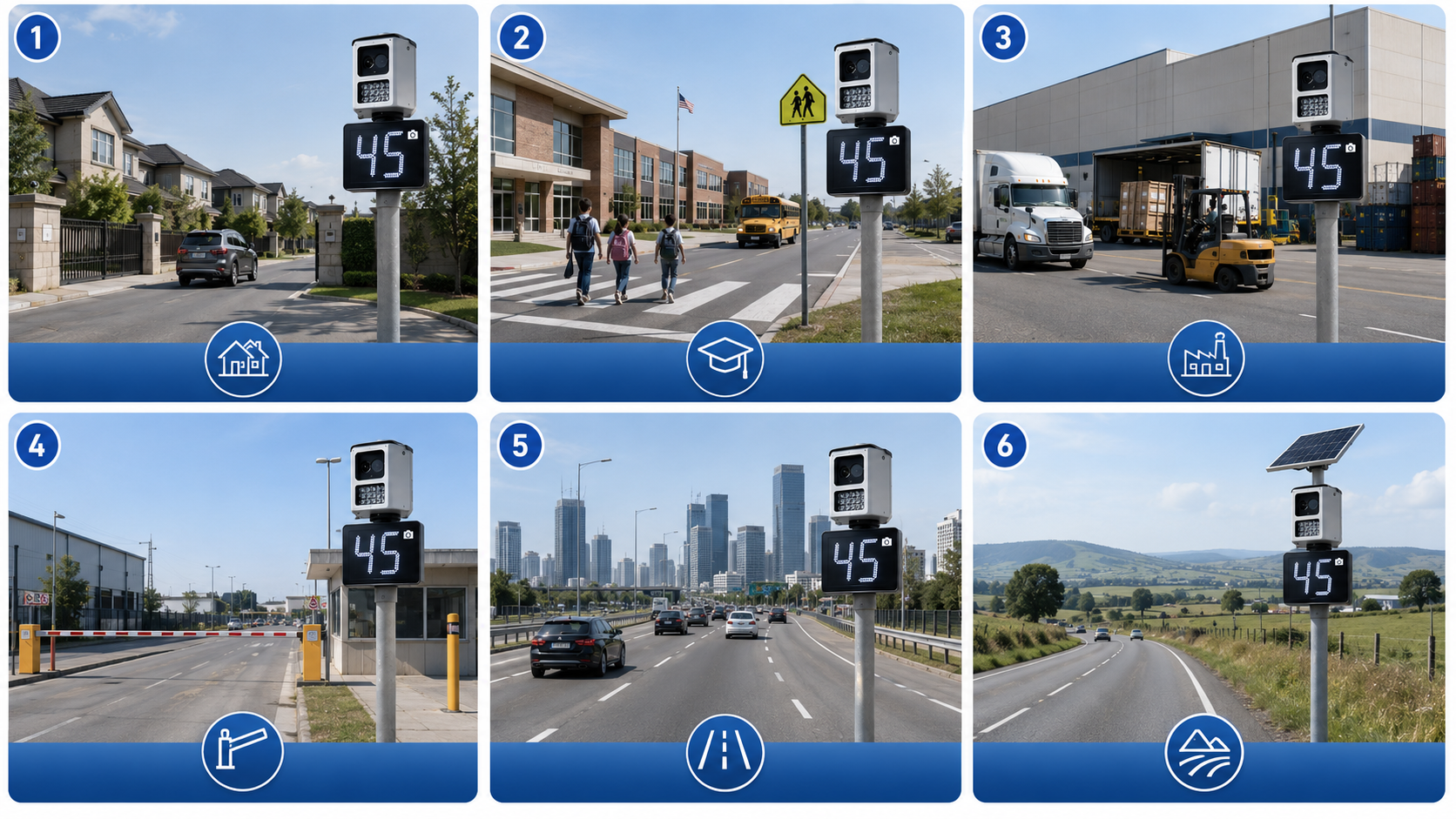
Because a camera with speed radar handles both monitoring and enforcement, you place it almost anywhere vehicles move too fast. The right grade changes with the site.
| Location | Why it fits |
| Private roads and communities | Gives an HOA hard proof of speeding, not just complaints |
| Schools and campuses | Warns drivers and records violations near children |
| Industrial parks and logistics yards | Controls speed around trucks, forklifts, and workers on foot |
| Factory and site perimeters | Logs every plate for access control and blacklist alerts |
| Urban roads and expressways | Enforces limits and feeds traffic data to the city |
| National and provincial highways | Covers fast, high-volume roads with all-weather capture |
| Rural and off-grid roads | Runs on solar and 4G where no mains power reaches |
For a private road or a gated community, a radar speed camera turns “people keep speeding here” into a documented case. On a campus or in an industrial park, it protects people on foot while keeping a record. On urban roads and highways, it supports formal enforcement and smart-city data. You can also read how communities tackle this in our guide on improving neighbourhood speed limit compliance.
How to Choose the Right Radar Speed Camera
Follow six steps and you will pick the right system the first time.
Step 1 — Define your goal. Do you want to monitor, deter, or formally enforce? This decides the grade of camera and platform you need.
Step 2 — Match speed and lanes. Confirm the speed range covers your road, and that the unit sees the lanes you need to watch.
Step 3 — Demand day and night capture. Insist on ANPR that reads plates clearly after dark, with built-in infrared. Night is when many violations happen.
Step 4 — Decide if you want to warn drivers. If deterrence matters, choose a model with an LED display that shows drivers their speed. You then warn and record at once.
Step 5 — Choose your power. Pick solar with battery for off-grid or remote sites. Pick AC mains for permanent urban installs.
Step 6 — Check the platform and support. Confirm the software gives you the data, reports, and access you need. Ask about OEM/ODM, warranty, and after-sales support.
The biggest mistake is buying on price alone. A cheap camera that misses plates at night gives you no usable evidence — and no return. Match the system to your site, and ask your supplier for a full spec sheet and a demo before you commit.
Radar Speed Camera vs. Radar Speed Sign: Which Do You Need?
This choice trips up many buyers, so make it early. Both use radar. They do different jobs.
A radar speed sign shows drivers their speed and warns them. It has no camera and keeps no record. It is simple, low-cost, and perfect when your goal is to calm traffic.
A radar speed camera adds a camera, ANPR, and a data platform. It captures violations and builds an evidence trail. It costs more, and it does far more.
| Feature | Radar speed sign | Radar speed camera |
| Main goal | Warn and calm traffic | Capture and enforce |
| Camera and plate capture | No | Yes |
| Evidence record | No | Yes |
| Best for | Schools, communities, quiet roads | Enforcement, highways, access control |
Here is the simple rule. If you only need drivers to slow down, a speed sign is enough. If you need to prove and act on violations, you need a camera with speed radar. Many buyers use both — signs to warn, and cameras where enforcement matters.
Why Source From a Specialist Manufacturer
Where you buy decides how well the system performs and how long it lasts. A cheap, generic camera fails at the worst moment — at night, in rain, or under a real caseload.
When you source from a specialist manufacturer, you get:
- Radar and ANPR built to work together. You get accurate speed and clean plate capture as one tuned system, not two mismatched parts.
- The right power version. You get solar with battery, or AC, sized for your site.
- A real management platform. You get the software that turns captures into usable data and evidence.
- OEM/ODM customisation. You add your branding, adjust the display, or tailor the configuration for a project.
- Proper support. You get a spec sheet, warranty, spare parts, and after-sales help.
If you plan an enforcement project, or you resell traffic systems to your own clients, this is the difference between a smooth rollout and a stream of failed captures. Send your requirements — your road type, speeds, lanes, power, and whether you need enforcement-grade evidence — and ask for a tailored recommendation and quote.
الخاتمة
A radar speed camera gives you what a plain camera and a radar gun never could on their own: precise speed and a clear, plate-level record, in one device. Keep three things in mind as you choose. First, decide whether you want to monitor, deter, or enforce — this sets the grade you need. Second, insist on all-weather, day-and-night capture, because weak evidence is no evidence. Third, look past the hardware to the platform that turns captures into data you can act on.
Get those three right, and a camera with speed radar becomes one of the most powerful tools on your road. It measures every vehicle, it captures the ones that break the limit, and it hands you the proof to act.
FAQ’s
What is the difference between a speed camera and an ANPR camera?
An ANPR camera reads licence plates. A radar speed camera adds a radar sensor, so it also measures each vehicle’s speed. Most modern speed enforcement cameras combine both — they read the plate and measure the speed in one device.
How does a radar speed camera decide a vehicle is speeding?
You set a speed limit for the location, and usually a small tolerance over it. The radar measures each vehicle’s speed and compares it to that limit. Only vehicles above the threshold trigger a capture.
Do radar speed cameras work at night?
Yes. Radar measures speed in any light, and built-in infrared lets the camera capture clear licence plates after dark — without depending on a bright flash.
Can a camera with speed radar read plates on fast-moving vehicles?
Yes. A quality unit freezes the vehicle cleanly and reads the plate as it passes, so you get a usable record even at speed. Confirm the exact speed range with your supplier for your road.
Can I use a radar speed camera on a private road or in a community?
Yes. Private roads, gated communities, campuses, and industrial parks are common uses. The camera gives you a documented record of speeding, which a plain security camera cannot provide.
Do I need mains power, or can it run on solar?
Both options exist. You can choose a solar-and-battery version for off-grid or remote sites, or an AC mains version for permanent urban installs.
What is section or average-speed enforcement?
It measures a vehicle’s average speed between two points, not just its speed at one spot. The system reads the plate at entry and exit, then calculates the average speed over that distance.
Can one camera cover more than one lane?
Many systems cover multiple lanes and track several vehicles at once. Confirm the lane coverage of the specific model against the road you plan to monitor.
Does a radar speed camera also warn drivers?
It can. Models with an LED display show drivers their speed as they approach, so you deter speeding and record violations at the same time.
What evidence does a radar speed camera produce?
A complete record for each violation: the vehicle’s speed, its licence plate, the time, the date, and the location — plus the captured image or video. That full package is what makes the record credible.
